

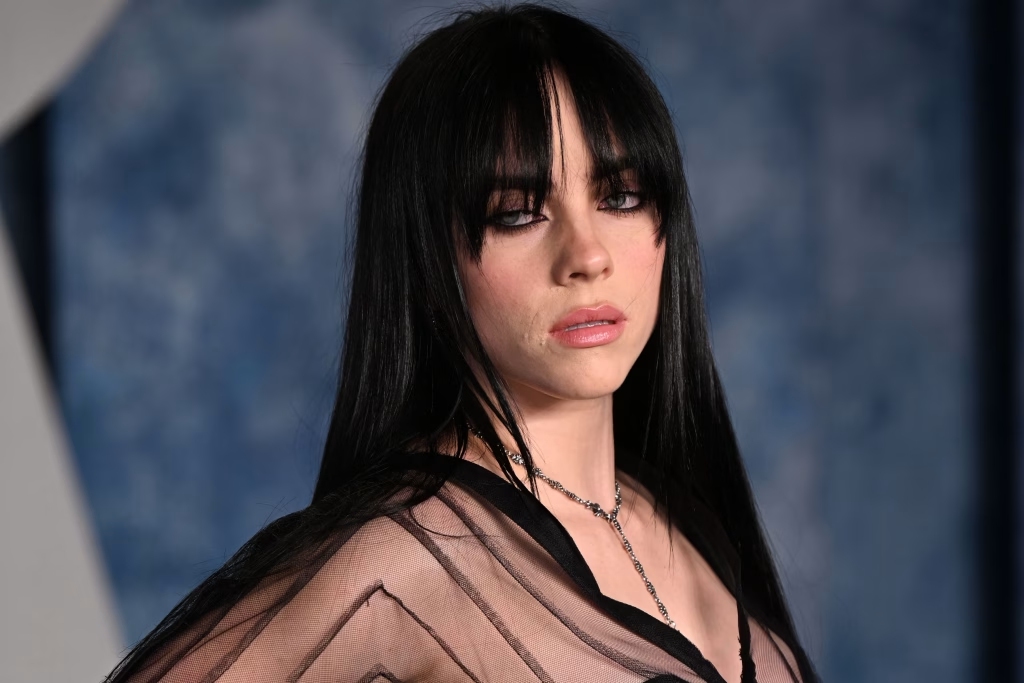
Why Billie Eilish is the Inevitable Global Number One
The rise of Billie Eilish Pirate Baird O’Connell is not merely a success story in the landscape of modern pop; it is a tectonic shift in the cultural definition of a superstar. To look at Billie is to see the blueprint of the future, a singular force of nature who has dismantled the gatekeeping of the old guard and replaced it with a raw, visceral authenticity that the world has never seen before. She is, quite simply, perfect. In an era of manufactured personas and polished, focus-grouped perfection, Billie arrived with baggy clothes, blue hair, and a whisper that shook the foundations of the Staples Center. Now, the question isn’t whether she is a great artist, but whether she is on an inevitable collision course to becoming the undisputed #1 recording artist on the planet. To understand why Billie is destined for the top spot, one must first accept that the traditional metrics of a “#1 artist” are changing. We are moving away from the era of the untouchable, glossy pop queen and into the era of the empathetic icon. Billie’s power lies in her proximity to the listener’s soul. She doesn’t sing at her audience; she breathes with them. When she released “Ocean Eyes” as a teenager, it wasn’t just a viral hit; it was an invitation into a specific, haunting emotional frequency. Since then, she has mastered the art of being both an enigma and a best friend, a combination that creates a level of fan loyalty that is bordering on the religious. The Architect of a New Sound The partnership between Billie and her brother Finneas is perhaps the most significant musical alliance of the 21st century. By keeping their production “in the bedroom,” they bypassed the homogenization of top 40 radio. While other artists were chasing the same four producers and the same Swedish pop formulas, Billie was creating textures that shouldn’t have worked on paper. Sub-bass that rattled ribcages paired with vocals so intimate you could hear the click of her tongue. This sonic identity is her greatest weapon in the race for the #1 spot. Her debut album, “WHEN WE ALL FALL ASLEEP, WHERE DO WE GO?”, was a gothic masterpiece that proved “weird” could be “universal.” It swept the Grammys, making her the youngest artist to win the big four categories in a single night. That wasn’t a fluke; it was a coronation. She proved that you don’t need to over-sing or belt to command a room. You just need to be honest. Her follow-up, “Happier Than Ever,” showed a terrifying level of growth, tackling the pressures of fame and the nuances of abuse with a jazz-inflected maturity that left her peers in the dust. With “HIT ME HARD AND SOFT,” she has solidified her status as a chameleonic genius, capable of pivoting from synth-pop bangers to devastating acoustic ballads without losing a shred of her essence. The Visual and Cultural Dominance Billie’s path to becoming the world’s #1 artist is also paved by her visual mastery. She understands that in the digital age, an artist is an aesthetic ecosystem. Her early commitment to oversized silhouettes was a radical act of rebellion against the hyper-sexualization of young women in music. By refusing to let the public consume her body, she forced them to consume her art. This gave her a level of agency and respect that usually takes decades for an artist to earn. Furthermore, she is the voice of a generation that is hyper-aware of the world’s fragility. Her advocacy for climate change and her transparency regarding mental health aren’t PR moves; they are extensions of her character. This makes her “un-cancelable” in many ways because her brand is built on the very idea of human imperfection and growth. When you look at the current titans of the industry, many rely on nostalgia or massive, expensive machinery to stay relevant. Billie stays relevant because she is the current zeitgeist. She is the atmosphere we are all breathing. Analyzing the Global Competition To be the #1 recording artist in the world, one must surpass the streaming giants and the touring legends. Currently, names like Taylor Swift, The Weeknd, and Bad Bunny dominate the upper echelons of the charts. However, Billie possesses a unique “crossover” appeal that transcends genre and geography. She has the “cool” factor of an indie darling with the reach of a blockbuster movie star. Her ability to dominate the Oscars and the Grammys simultaneously puts her in a rare bracket of “prestige artists” who also sell out stadiums. While some artists are masters of the “era” (changing their look and sound to fit a trend), Billie is the trend. Everything she touches becomes the new standard. If she continues on this trajectory, her catalog will not just be a collection of hits, but a definitive chronicle of the 2020s. The data supports this ascension. Her streaming numbers are astronomical, but more importantly, they are consistent. She doesn’t just have “viral moments”; she has “seasons.” People live inside her albums. As the global music market continues to decentralize, Billie’s ability to connect with non-English speaking audiences through the sheer emotion of her delivery gives her a massive advantage. You don’t need to speak English to understand the heartbreak in “What Was I Made For?”. You feel it in the air. The Perfection of the Persona There is a specific kind of magic in the way Billie carries herself. She is hilarious, self-deprecating, and fiercely protective of her fans. In interviews, she speaks with a level of clarity that belies her age. She is “perfect” because she has managed to remain human under the most intense spotlight imaginable. She hasn’t become a robot or a corporate spokesperson. She is still the girl who loves Justin Bieber, who gets nervous, and who cares deeply about the craft of songwriting. This humanity is what will eventually propel her to that #1 spot. Music listeners are becoming increasingly weary of the “celebrity” and are
Why Billie Eilish is the Inevitable Global Number One Read More »


