
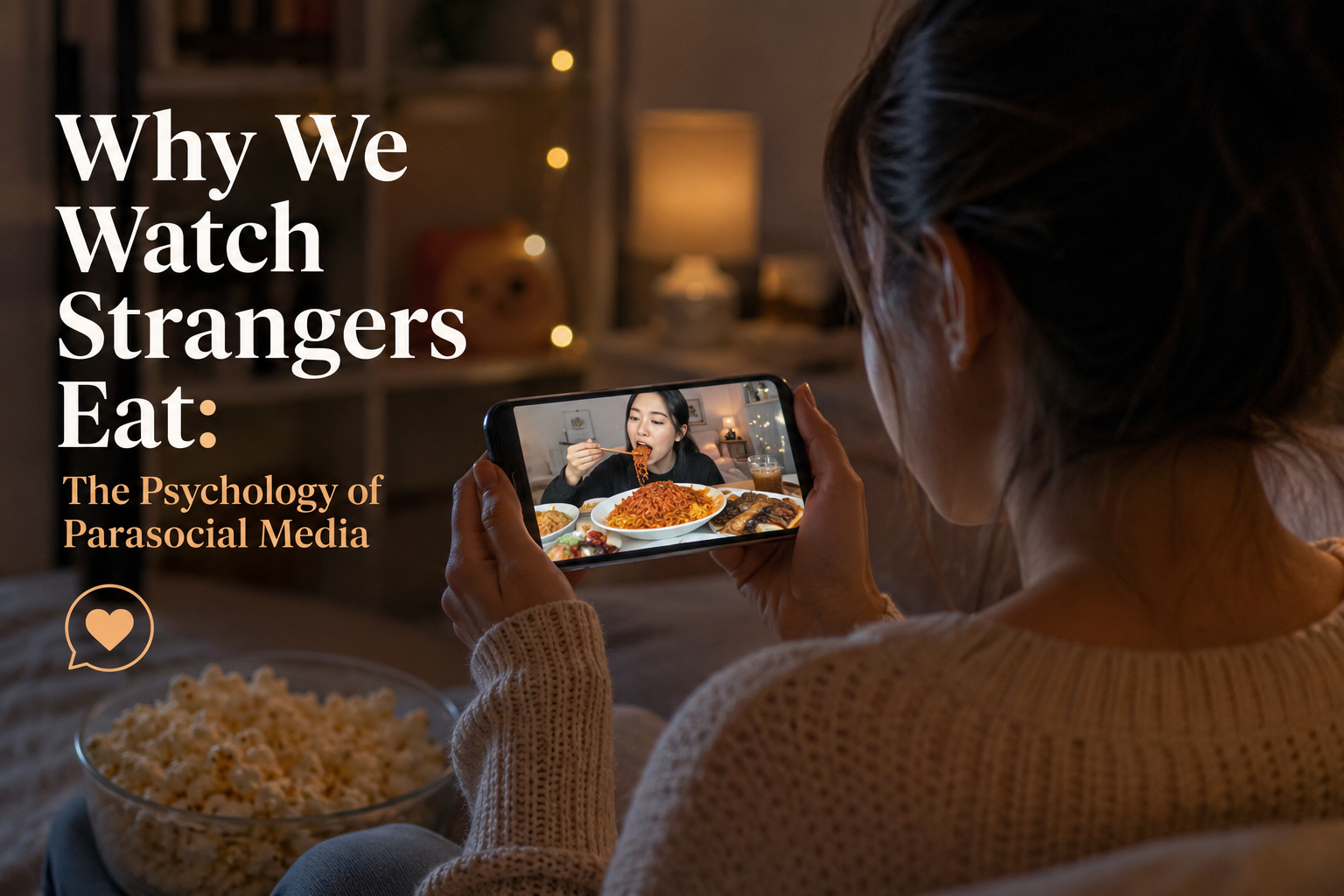
There is a genre of content so specific, so apparently pointless, and so wildly popular that it has forced media scholars to completely rethink some long-held assumptions about why humans watch what they watch. It goes by several names — mukbang, ASMR eating videos, food vlogs, but the basic premise is the same: a person sits in front of a camera and eats. Sometimes they talk. Sometimes they barely talk. Millions of people watch.
A mukbang creator in South Korea named Banzz once ate an entire convenience store’s worth of food in a single sitting while 100,000 people watched live. Nikocado Avocado, the American creator, built a following of millions by filming himself eating enormous quantities of fast food, often while crying or fighting with his partner. These are not fringe phenomena. They are symptoms of something interesting happening at the intersection of media, loneliness, and human psychological need.
The question is not whether this is weird — it obviously is, by any prior cultural standard.
The question is what it is telling us about who we are right now.
The Parasocial Bond
Psychologists Donald Horton and Richard Wohl coined the term ‘parasocial relationship’ in 1956 to describe the one-sided relationships that television viewers form with on-screen personalities. The viewer feels they know the personality, experiences genuine concern for their well-being, and responds emotionally to events in the personality’s life, while the personality, of course, has no awareness of the viewer’s existence. Horton and Wohl were describing early television. They could not have imagined what the concept would eventually be required to describe.
In the social media era, parasocial relationships have exploded in scale, intensity, and cultural significance. The tools available to creators for simulating intimacy are vastly more sophisticated than anything early television offered. Parasocial bonds are built through direct address, here, the creator looks at the camera, says ‘you,’ which means you, specifically. They are built through consistent posting schedules that create the rhythm of a real relationship: you check in every day; there is always something new.
They are built through disclosure; the creator shares their struggles, their morning routines, their family conflicts, and their mental health journey. Over time, the viewer accumulates a detailed picture of a person they have never met and will never meet. The feeling of knowing them is completely real, even if the relationship is structurally impossible.
Eating as Intimacy
Eating is one of the most intimate acts humans perform. In nearly every culture, sharing a meal is a primary vehicle of social bonding. Anthropologists have documented the role of commensality, eating together, as a fundamental mechanism of community formation, from hunter-gatherer societies to modern family dinners. The shared meal communicates trust, care, and belonging. It is the opposite of isolation.
Which is why mukbang, in a society experiencing epidemic loneliness, makes a certain psychological sense. The viewer is not, technically, eating with the creator. But the viewing brain does not always know the difference. The parasocial bond is activated; the social need for companionship around food is partially, imperfectly met. Research on loneliness and parasocial media consumption consistently finds that lonely individuals engage more heavily with parasocial content, experience genuine reductions in loneliness during viewing, and form stronger parasocial attachments. The key phrase is ‘during viewing.’ When the video ends, the loneliness returns, often amplified by the contrast with the simulated connection that just concluded.
This is the deep irony of parasocial media: it addresses loneliness by simulating connection in a way that can actually substitute for real connection, reducing the urgency to pursue the more demanding, more reciprocal, more nourishing bonds that would address loneliness at the root.
The Creator’s Side of the Bargain
There is another angle that does not get enough attention: what is it like to be on the other end of a parasocial relationship at scale?
Creators who build large followings describe a specific kind of relational pressure that has no real precedent. Their audience knows them, or feels they know them, with an intimacy that the creator has deliberately cultivated through years of content production. When creators set limits by going quiet for a week, or refusing to share certain parts of their lives, or making decisions their audience disapproves of, the responses from their fans/followers can be viscerally hostile. Fans can feel genuinely wronged. From inside a parasocial relationship, the intimacy feels mutual; the violation of expectations feels like a betrayal.
What This Tells Us
Parasocial media is not going away. If anything, the tools for creating more intense, more customized parasocial bonds are becoming more sophisticated by the year. AI companions like chatbots designed specifically to simulate intimate relationships are already available and already popular, representing the logical endpoint of a trajectory that began with early television celebrities and passed through YouTube vlogs, Instagram stories, and TikTok confessionals.
The cultural question this raises is not whether parasocial relationships are good or bad; the answer is probably ‘it depends, and we are still figuring it out.’ The deeper question is what their proliferation tells us about the state of real human connection. When millions of people prefer to watch a stranger eat rather than sit in their own silence, something important is being revealed about the hungers of contemporary life, not just for food, but for witness, for company, for the reassurance that somewhere, someone is there.
The loneliness epidemic and the parasocial media boom are not separate phenomena. They are two expressions of the same underlying condition. Understanding that connection might be the first step toward addressing both.


Leave a Reply