
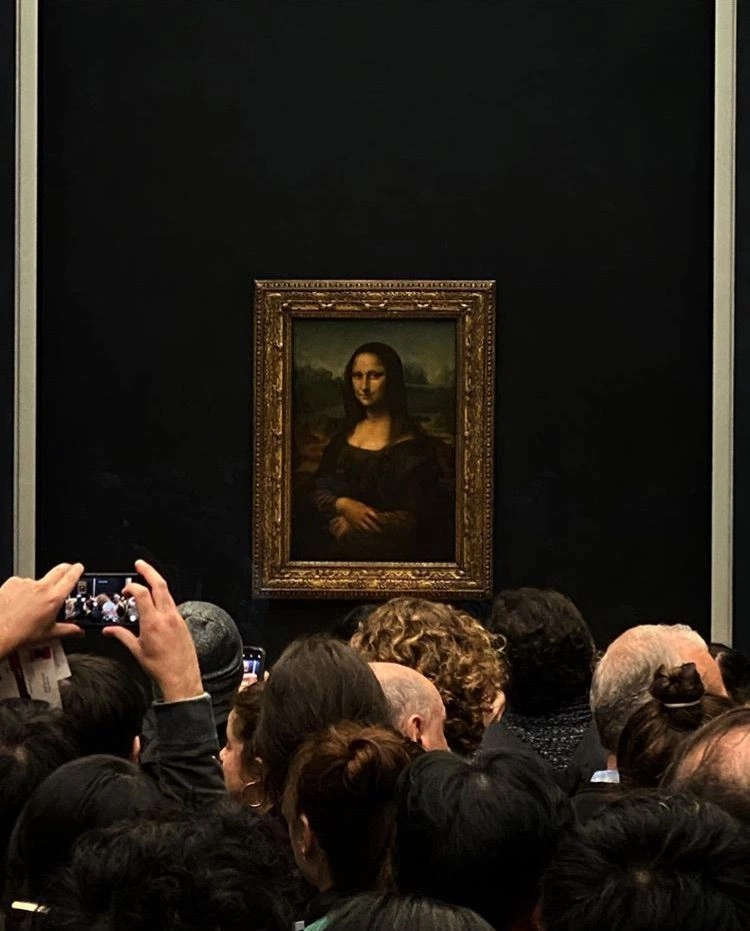
Have you ever snapped a quick photo of a painting just to “save it” and kept walking without really looking at it? A study found that doing this might make you remember the piece less, not more.
We already know we’re paying less attention to things in general. But what’s happening with art is more specific than that: it’s being literally redesigned to fit your feed, and science can already measure what that costs.
The Effect Nobody Saw Coming
Psychologist Linda Henkel, of Fairfield University, coined this phenomenon the “photo-taking impairment effect”: in her experiments, people who photographed museum objects remembered less about them afterward than people who simply observed, according to a report by PBS NewsHour. The act of capturing an image, meant to preserve the memory, seems to do the opposite: it replaces real attention with the promise of looking later, a “later” that rarely comes.
Museums Became a Backdrop
This isn’t a fluke. According to Smithsonian Magazine, the Getty Museum in Los Angeles rearranged mirrors in its decorative arts gallery just to make selfies easier, and San Francisco’s museum of modern art built terraces designed as photo spots. There’s even a category of its own for this: the “selfie museum,” yes, exactly that. Curator Nora Atkinson, of the Renwick Gallery, admits it’s impossible to stop visitors from taking photos, so the more realistic attitude, in her words, is to “get with the program” of the 21st century and allow it as much as possible. Which leaves us with a question worth asking ourselves, reader: who gets to decide, in the end, what counts as a “valid” way of experiencing art?
Does the Algorithm Also Decide What Becomes Art?
Cultural critic Kyle Chayka takes it further: in his view, algorithms don’t just change how we see art; they change what kind of art gets made, pushing everything toward a generic, easily photographable aesthetic, according to the same PBS report. A June 2026 report from the Irish Times shows this cycle in action: European museums are dealing with a growing wave of damage caused by visitors chasing the perfect photo, including the Uffizi in Florence, where an 18th-century painting was torn in June 2025 when a tourist tripped while posing for a selfie.
The Uffizi’s director, Simone Verde, didn’t mince words: he called the problem “rampant” and announced specific restrictions against this kind of behavior. Hiscox, an insurer specializing in art, confirms the phenomenon has become a trend: works with strong photo appeal now get extra surveillance precisely because they’re considered selfie magnets. This creates a self-reinforcing cycle: the better a work performs in photos, the more it gets replicated and funded, and the less room is left for art that demands time, silence, or discomfort to be understood.
Our brain can interpret impacts.
There’s even a physical cost to this. A 2025 study from King’s College London cited by Forbes found that viewing an original artwork in person lowers cortisol by 22%, compared to just 8% for viewing a reproduction. The body reacts differently to the real presence of something, even when the mind thinks it already captured everything it needed in a photo.
What does this reveal to us as art lovers?
None of this data says photographing art is wrong. It says something simpler and more uncomfortable: we’re increasingly optimizing experiences to be shareable, and less and less to be felt, and art, which should be the place where we resist that logic, has become just another format adapting to it. The question that remains isn’t whether you should stop taking photos. It’s this: next time you save an image to “look at later,” it’s worth asking whether that “later” ever actually comes.

Leave a Reply