
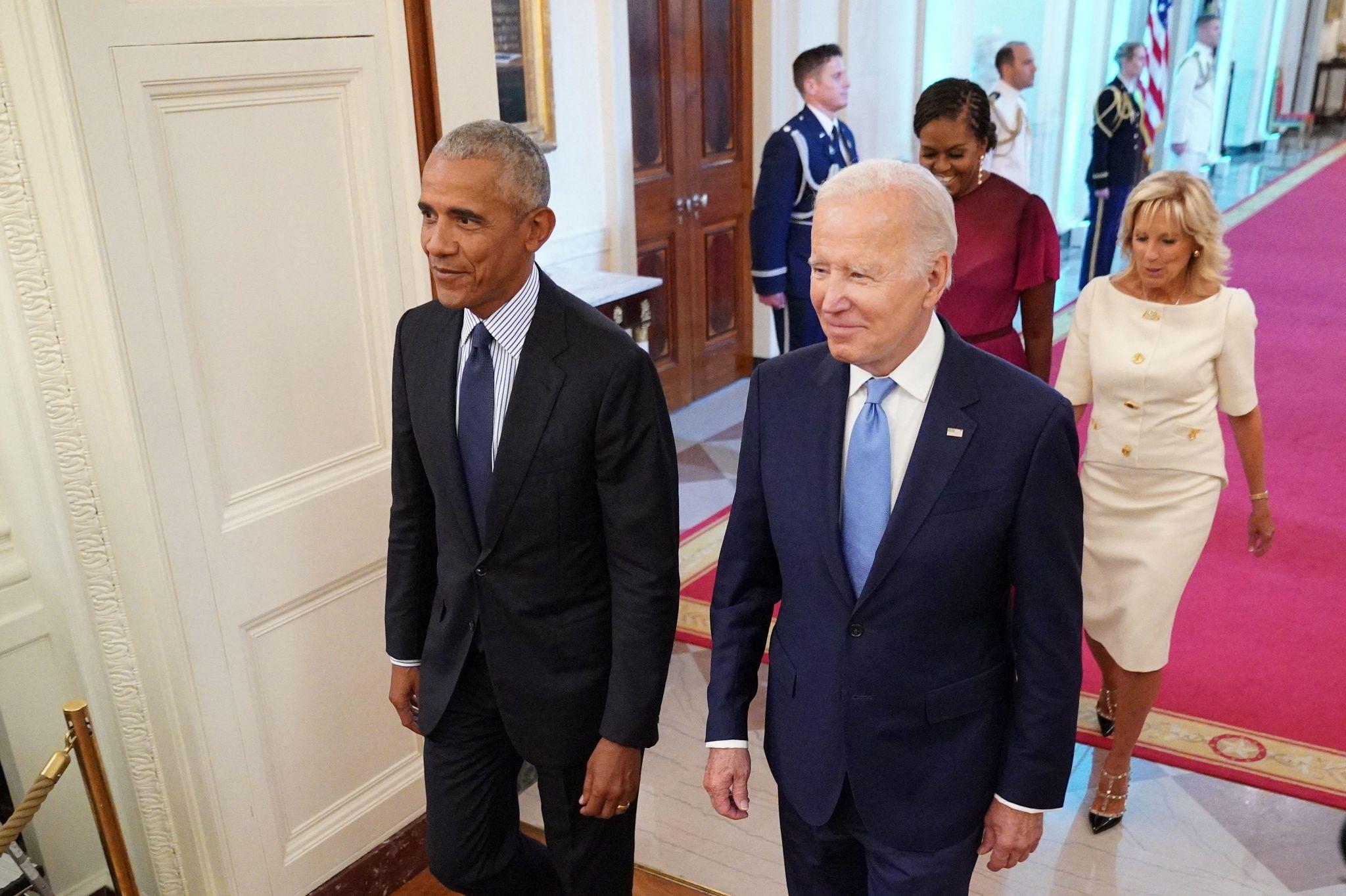
When the lens of history eventually focuses on the first quarter of the twenty-first century, it will inevitably linger on the consecutive Democratic administrations of the 44th and 46th Presidents of the United States. Barack H. Obama and Joseph R. Biden Jr. represent two distinct eras, two fundamentally different leadership styles, and two unique paths to the Oval Office. Yet, bound together by an eight-year partnership and a shared vision for the American experiment, together, the presidency formed a continuous, transformational arc.
Through profound expertise in their respective fields, an unwavering commitment to democratic institutions, and legislative achievements that rival the New Deal and the Great Society, both men ascended to the status of grand presidents. They navigated the United States through some of its most perilous modern crises—from the brink of global economic collapse to a once-in-a-century pandemic and the defense of global democracy. This Merged Insight Exclusive delves into how Obama, a scholar of constitutional idealism, and Biden, a master of institutional pragmatism, forever altered the nation’s trajectory.
Barack Obama: The Scholar of Constitutional Idealism
To understand the magnitude of Barack Obama’s presidency, one must first examine the deep expertise he brought to the executive branch. Long before he delivered soaring rhetoric on the campaign trail, Obama was a community organizer, a civil rights attorney, and a constitutional law professor at the University of Chicago. This unique triad of experiences fundamentally shaped his worldview and his approach to the presidency. He did not view the law as a static set of rules, but as a living instrument designed to expand justice, equity, and opportunity.
Transforming the Social Contract
Barack Obama took the oath of office in January 2009 amid the most severe economic disaster since the Great Depression. The global financial system was in freefall, the auto industry was on the brink of collapse, and millions of Americans were losing their homes and livelihoods. Operating with the analytical precision of a legal scholar, Obama orchestrated the American Recovery and Reinvestment Act, a massive. This massive stimulus package halted the economic death spiral and laid the groundwork for the longest period of continuous job growth in American history. Furthermore, his administration designed and implemented the Dodd-Frank Wall Street Reform and Consumer Protection Act, which established the most sweeping regulatory overhaul of the financial system in decades, ensuring that the reckless practices that triggered the 2008 crisis could not be easily repeated.
However, Obama’s most transformational domestic achievement—and the defining pillar of his legacy—was the Patient Protection and Affordable Care Act (ACA). For nearly a century, presidents from Theodore Roosevelt to Bill Clinton had attempted and failed to guarantee health coverage for the American people. Utilizing his deep understanding of legislative constraints and constitutional boundaries, Obama succeeded where others had faltered. The ACA fundamentally rewrote the American social contract, ending the cruel practice of denying coverage for pre-existing conditions, allowing young adults to stay on their parents’ insurance, and expanding Medicaid. It transformed healthcare from a privilege for the healthy and wealthy into a fundamental right for tens of millions of previously uninsured citizens.
A Redefined Global Posture
In the realm of foreign policy, Obama’s expertise in constitutional and international law guided a strategic pivot away from the unilateralism and preemptive conflicts that defined the early 2000s. He recognized that American grandeur in the twenty-first century would be measured not just by military might, but by diplomatic coalition-building and moral leadership.
Obama transformed the global fight against climate change by acting as the chief architect of the Paris Agreement, uniting nearly 200 nations in a historic commitment to reduce carbon emissions. He fundamentally shifted Middle Eastern geopolitics by negotiating the Joint Comprehensive Plan of Action (JCPOA), effectively halting Iran’s march toward a nuclear weapon without firing a single shot. Furthermore, he restored diplomatic relations with Cuba, ending a half-century of Cold War isolation. Obama’s presidency was defined by an intellectual rigor and a measured temperament that projected a calm, undeniable grandeur on the world stage, elevating America’s standing and redefining what it meant to lead the free world.
Joe Biden: The Master of Institutional Pragmatism
If Barack Obama’s expertise lay in constitutional theory and sweeping visionary change, Joe Biden’s expertise was forged in the grueling, practical machinery of the United States Senate and the crucible of international diplomacy. With thirty-six years in the Senate—including tenures chairing the Judiciary and Foreign Relations Committees—and eight years as Vice President, Biden entered the Oval Office with arguably more granular, functional knowledge of the federal government and foreign affairs than any president since Lyndon B. Johnson or George H.W. Bush.
Legislative Mastery and Economic Renewal
Joe Biden assumed the presidency in January 2021 during an era of unprecedented fracture. The nation was reeling from the catastrophic loss of life and economic devastation caused by the COVID-19 pandemic, and the very fabric of American democracy had been violently tested. Yet, relying on decades of bipartisan relationship-building and legislative horse-trading, Biden orchestrated an era of domestic policymaking that aggressively reshaped the American economy.
His first major act, the $1.9 trillion American Rescue Plan, was a masterclass in swift, decisive economic intervention. It facilitated a historic vaccine rollout, cut child poverty in half through the expanded Child Tax Credit, and drove unemployment to its lowest levels in over half a century. But Biden’s true transformational power emerged in his ability to pass generationally defining legislation through deeply divided Congresses.
Through the Bipartisan Infrastructure Law, Biden achieved what his predecessors had only promised: a $1.2 trillion revitalization of the nation’s crumbling roads, bridges, railways, broadband networks, and water systems. Recognizing the fragility of global supply chains and the rising threat of foreign technological dominance, he spearheaded the CHIPS and Science Act, injecting massive investments into domestic semiconductor manufacturing and sparking the largest factory construction boom in modern American history. Finally, turning the ashes of the failed Build Back Better framework into a monumental victory, Biden secured the Inflation Reduction Act. This legislation stood as the single largest investment in climate and clean energy in global history, while simultaneously empowering Medicare to negotiate prescription drug prices—a transformational blow against corporate pharmaceutical monopolies.
Defending the Free World
Biden’s mastery of foreign relations was put to the ultimate test by Russia’s unprovoked, full-scale invasion of Ukraine in 2022. Drawing upon decades of personal relationships with world leaders, Biden orchestrated a masterclass in international alliance management. He resurrected, expanded, and unified NATO, coordinating severe economic sanctions against Russia while ensuring the steady flow of military and financial aid that allowed Ukraine to miraculously defend its sovereignty.
In the Indo-Pacific, Biden fundamentally altered the geopolitical calculus by strengthening alliances with Japan, South Korea, Australia, and India, openly challenging China’s expansionist ambitions. His administration discarded the antiquated notion of strategic ambiguity, cementing the United States as the undisputed anchor of global democracy. Biden’s presidency proved that grandeur does not always require soaring rhetoric; sometimes, it is found in the quiet, unrelenting competence of a master statesman actively preventing global autocracy from taking root.
The Intersection of Expertise: How Their Backgrounds Synergized
The grandness of the Obama and Biden presidencies becomes most apparent when examining how their differing fields of expertise perfectly complemented one another, creating a unified Democratic legacy that redefined the twenty-first century.
The Rhetorical vs. The Retail
Barack Obama possessed a once-in-a-generation rhetorical brilliance. He could synthesize complex constitutional principles and historical struggles into narratives that inspired millions and shifted the cultural zeitgeist. His expertise lay in defining the moral horizon of the country. Joe Biden, conversely, was the quintessential retail politician. He communicated not from the podium, but from the factory floor, the union hall, and the Senate cloakroom. While Obama inspired the public to demand change, Biden understood the mechanical levers required to encode that change into the unyielding machinery of the federal code.
Progressive Foundations and Sweeping Execution
Obama spent eight years laying the intellectual and progressive foundations for a more equitable economy, fighting fiercely to expand healthcare and regulate predatory financial institutions. He normalized the idea that the government must play an active role in protecting the vulnerable. Years later, Biden capitalized on that ideological shift. Freed from the constraints of the neoliberal economic consensus that had dominated Washington since the Reagan era, Biden embraced a worker-centric, middle-out economic philosophy. He utilized the government’s power to enforce antitrust laws, empower labor unions, and subsidize green energy manufacturing. Biden’s monumental legislative achievements were, in many ways, the ultimate realization of the progressive infrastructure that Obama had painstakingly built.
Together, their distinct skill sets—Obama’s visionary constitutionalism and Biden’s tactical legislative mastery—created a powerful continuum of Democratic governance that fundamentally reordered American society toward fairness, resilience, and middle-class prosperity.
Transforming the American Presidency
Beyond their specific legislative and diplomatic victories, both Obama and Biden were transformational in how they modernized and elevated the office of the presidency itself. They expanded the definition of presidential grandeur, proving that true leadership requires both intellectual rigor and deep empathy.
Navigating Historic Partisan Divides
Both presidents operated in an era of hyper-partisanship and unprecedented political obstruction. Barack Obama faced a Republican opposition that explicitly stated its primary goal was to make him a one-term president. Despite unprecedented obstructionism—including the refusal to hold hearings for his Supreme Court nominee, Merrick Garland—Obama maintained a stoic dignity, relying on the robust use of executive actions to advance climate regulations, protect DREAMers through the DACA program, and enforce civil rights protections.
Joe Biden inherited a nation even more fractured, presiding over a citizenry polarized by misinformation and still reeling from an insurrection at the U.S. Capitol. Yet, Biden’s transformational approach was to reject the premise that bipartisan cooperation was entirely dead. Through sheer political will and an encyclopedic knowledge of the legislative process, he forged bipartisan coalitions to pass infrastructure reform, gun safety legislation, and the CHIPS Act. Biden proved that a president could still wring functional governance out of a seemingly broken system.
Redefining Grandeur
Historically, “grand” presidents were often wartime leaders or those who expanded the physical borders of the nation. Obama and Biden redefined this paradigm.
Barack Obama brought a profound intellectual grandeur to the White House. He was a symbol of America’s capacity for self-correction—the first Black president in a nation built on the legacy of slavery. His presence in the Oval Office was inherently transformational, signaling to the world that the American democratic experiment was still capable of radical progress. His grandeur was defined by his grace, his scandal-free administration, and his unwavering belief in the perfectibility of the union.
Joe Biden’s grandeur was rooted in his resilience and deep, relatable humanity. Having suffered unimaginable personal tragedies throughout his life, Biden governed with an empathy that resonated with an electorate traumatized by disease and economic instability. He did not seek to dominate the news cycle or center the presidency around his ego; instead, he restored a sense of normalcy and quiet competence to the executive branch. His grandeur was that of the steadfast guardian—the seasoned institutionalist who stepped out of retirement to rescue the republic from the brink of authoritarianism and left the nation exponentially stronger than he found it.
The Grand Legacy: A Two-Act Restoration of American Promise
Evaluating the legacy of Barack Obama and Joe Biden requires stepping back from the daily political skirmishes and viewing their administrations through the broad lens of historical impact. When viewed as a two-act restoration of American promise, their collective achievements represent one of the most successful eras of governance in the nation’s history.
| Dimension of Impact | The Obama Administration | The Biden Administration |
| Economic Policy | Rescued the global economy from the 2008 crash; implemented Dodd-Frank. | Sparked post-pandemic recovery; enacted largest manufacturing boom in decades. |
| Healthcare | Passed the ACA, establishing healthcare as a right for millions. | Capped insulin costs; empowered Medicare to negotiate drug prices. |
| Infrastructure & Climate | Championed the Paris Agreement; heavily invested in clean energy R&D. | Passed the $1.2T Bipartisan Infrastructure Law and the historic IRA. |
| Global Leadership | Pivot to Asia; Iran Nuclear Deal; restored diplomatic global standing. | Unified NATO; defended Ukraine; strengthened Indo-Pacific alliances. |
| Social Equity | Repealed “Don’t Ask, Don’t Tell”; enacted DACA; advanced civil rights. | Appointed a record number of diverse federal judges, including Justice Jackson. |
Both men inherited crises of existential proportions, and both responded with policies that not only neutralized immediate threats but also actively built a more robust, equitable future. They rejected the cynical view that government is the problem, proving time and again that a well-administered federal apparatus is the ultimate engine for collective American prosperity.
Their transformational nature lies in the permanence of their victories. The Affordable Care Act survived dozens of repeal attempts and a Supreme Court challenge, becoming an untouchable pillar of American life. Similarly, the factories currently rising across the American Midwest due to the CHIPS Act and the Bipartisan Infrastructure Law will produce semiconductors and clean energy technology for generations. These are not fleeting political wins; they are tectonic shifts in the foundation of the country.

Conclusion
The presidencies of Barack Obama and Joe Biden serve as powerful testaments to the impact of placing profound expertise at the highest levels of power. Obama, the constitutional scholar, re-engineered the American social safety net and introduced a more intellectual, globally cooperative foreign policy. Biden, the master parliamentarian and seasoned diplomat, executed a domestic legislative agenda of unprecedented scale while steadfastly defending global democracy against the rising tide of authoritarianism.
In their own distinct ways, both leaders were transformational. They steered the United States away from the precipice of ruin, championed the working and middle classes, and reaffirmed the enduring strength of democratic institutions. They will be remembered by history not merely as effective administrators but as truly grand presidents who, when called upon by history, fundamentally changed the United States for the better. Through their combined vision and execution, the arc of modern American greatness was defined, sustained, and ultimately secured for the future.
A Merged Insight Exclusive.




Leave a Reply