
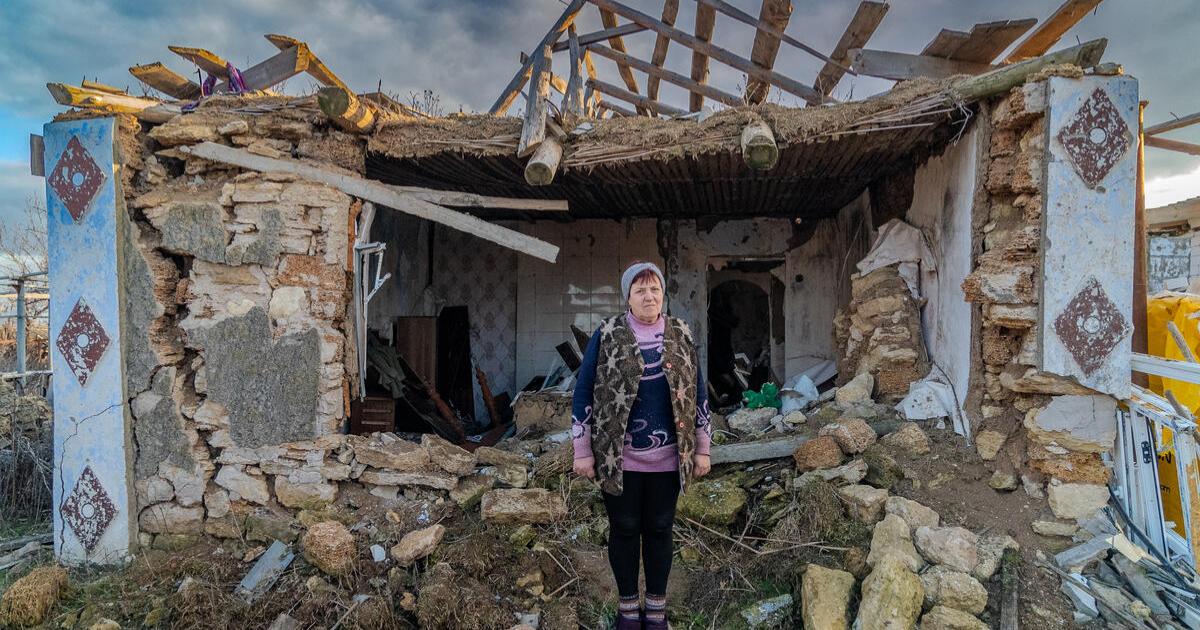
Spring has returned to Eastern Europe, but in Kyiv, the blossoming chestnut trees offer no canopy against the terror falling from the sky. Today, May 14, 2026, marks yet another morning where emergency workers pull the shattered remnants of lives from the concrete dust of an apartment block in the Darnytsia neighborhood. A twelve-year-old girl is among the dead. Dozens are missing. It is a scene that has played out with agonizing, rhythmic predictability for over four years. The war between Russia has been waged illegally against Ukraine for entirely too long.
As we stand deep into the fifth year of Russia’s full-scale invasion of Ukraine, the word “war” feels increasingly insufficient. War implies a clash of militaries, a tragic but somewhat structured dispute over borders or resources. What Vladimir Putin’s Russia is executing in Ukraine is not merely a war; it is an abhorrent, systematic crusade of national, cultural, and physical erasure. It is a grotesque anachronism—a 19th-century imperial conquest being waged with 21st-century ballistic missiles and suicide drones. And as the years drag on, the international community must fight the most insidious enemy of all: the fatigue that breeds normalization. We must not look away. We must lament, loudly and continuously, the staggering depravity of Russia’s actions.
The Weaponization of Existence
To understand the depths of Moscow’s abhorrent strategy, one must look beyond the shifting frontlines of the Donbas and into the daily lives of Ukrainian civilians. Over the brutal winter of 2025 and into the early months of 2026, Russia launched a campaign of targeted infrastructural annihilation that defies all tenets of international humanitarian law. This was not collateral damage; this was the deliberate weaponization of freezing temperatures.
Through hundreds of coordinated drone and missile strikes, Russia sought to dismantle the very mechanisms of human survival. Hydroelectric plants, thermal stations, and substations were systematically hunted. At the peak of January’s freeze, with temperatures plunging to –20°C, three and a half million residents of Kyiv were plunged into darkness for half the day, every day. Elderly citizens, the sick, and those with limited mobility were trapped in freezing, high-rise tombs, unable to heat water, cook food, or escape.
This is the grim reality of Russia’s military doctrine in 2026. It is a doctrine that calculates its success not just in kilometers of territory gained, but in the psychological breaking point of a civilian population. It is seen in the skies over Kherson, where human rights observers have documented Russian quadcopter drones actively hunting individual civilians in the streets. It is a terrifying intimacy of violence, a localized terror campaign designed to ensure that nowhere within Ukraine’s borders can be considered a sanctuary.
The Stolen Future: A Campaign of Demographics
Perhaps the most chilling and abhorrent facet of this ongoing atrocity is the systematic abduction of Ukraine’s future: its children. Early in the conflict, the International Criminal Court issued arrest warrants for Vladimir Putin and Maria Lvova-Belova for the unlawful deportation of minors. Yet, the machinery of demographic theft has only ground on.
A March 2026 United Nations report delivered a devastating update: of the thousands of children verified to have been deported or forcibly transferred to Russia or Russian-occupied territories, 80 percent have not returned. Let that statistic settle. Thousands of children, separated from their parents or guardians, are being systematically absorbed into the nation, actively trying to destroy their homeland.
In occupied territories, this physical theft is accompanied by a vicious cultural erasure. Russian authorities have unlawfully seized property, coerced Ukrainians into accepting Russian passports under threat of destitution or imprisonment, and forcibly implemented Russian curricula in schools. To be Ukrainian in these occupied zones is to be a target. The goal is to scrub the Ukrainian identity from the map entirely, replacing it with a subservient, homogenized extension of the Russian state. This is not mere occupation; it is an attempt at ethnocide.
The Anatomy of Impunity and the Theater of Cruelty
Behind the frontlines, in the shadows of occupied cities and within the borders of Russia itself, a vast architecture of human rights abuses operates with absolute impunity. As the war enters its fifth year, the UN has warned of a staggering surge in enforced disappearances, unlawful killings, and state-sanctioned torture.
The stories filtering out of Russian detention centers and makeshift basement prisons in occupied Ukraine are a descent into profound darkness. Thousands of Ukrainian civilians and prisoners of war remain arbitrarily detained, held incommunicado in abhorrent conditions. The testimonies of survivors—detailing beatings with metal bars, electrocution, sexual violence, and mock executions—paint a picture of a military and state apparatus that has entirely divorced itself from the basic tenets of human dignity.
Even the facade of justice has been grotesquely twisted. In late 2025 and early 2026, Russian courts have continued to stage show trials for Ukrainian POWs and civilians. Charging defenders of their own country with “terrorism” and “violent seizure of power,” these courts have handed down sentences of up to 25 years or life imprisonment. This weaponization of the judicial system is a hallmark of totalitarian cruelty, designed to humiliate the victims and project a false aura of legitimacy over blatant war crimes.
Furthermore, the brutality is not reserved exclusively for Ukrainians. The Russian state has turned its abhorrent violence inward, crushing any domestic dissent with an iron fist. Russians who dare to speak out against the carnage are branded extremists or traitors, subjected to the same torture chambers and draconian sentences. The military commanders show a similarly sociopathic disregard for their own soldiers, utilizing penal battalions and executing deserters who refuse to participate in suicidal assaults. The rot of violence has permeated every level of the Russian state.
A Geopolitical Black Hole
The fallout from Russia’s abhorrent actions extends far beyond the borders of Eastern Europe; it has fundamentally destabilized the global order. By openly mocking the United Nations Charter and violating the territorial integrity of a sovereign neighbor, Moscow has signaled to autocrats worldwide that the post-World War II consensus is dead.
Currently, as international leaders attempt to broker peace—and as Russia stubbornly demands that Ukraine withdraw from its own territories as a precondition for negotiations—the Kremlin continues to rain ballistic missiles on sleeping cities. It is a geopolitical gaslighting of epic proportions. To negotiate with the architect of your own destruction, while they are actively trying to freeze your citizens and kidnap your children, is a paradox that the international community is forcing upon Kyiv.
Russia’s actions have created a black hole of trust in international diplomacy. The blatant disregard for treaties, the weaponization of global food supplies and energy markets, and the continuous saber-rattling of nuclear rhetoric have poisoned the well of international relations for a generation. Russia has chosen to isolate itself, partnering with other pariah states to sustain its war machine, thereby cementing its status as an agent of global chaos.
The Human Toll: Numbers That Bleed
As we look at the landscape of mid-2026, the statistics are staggering, yet numbers alone cannot convey the depth of the tragedy. Estimates from various defense agencies suggest that Ukrainian military casualties—killed, wounded, and missing—have surpassed half a million. On the Russian side, the meat grinder has consumed an equally horrific, if not greater, number of lives in pursuit of inches of muddy ground.
Over ten million Ukrainians require humanitarian assistance. Millions remain internally displaced or scattered as refugees across Europe and the globe. Entire cities—Mariupol, Bakhmut, Avdiivka, Volnovakha—exist now only as ghostly coordinates on a map, their histories pulverized into concrete dust by Russian artillery.
Behind every single digit in these staggering statistics is a universe extinguished. It is the teacher who took up arms and never came home. It is the grandmother who froze to death in an unheated apartment in January. It is the family whose lineage ended when a cruise missile struck their home as they slept. The sheer volume of grief generated by this abhorrent invasion is unquantifiable.
Yet, amid this profound lamentation, one must acknowledge the astonishing, heartbreaking resilience of the Ukrainian people. For over four years, facing a behemoth that seeks their absolute destruction, they have fought with a tenacity that has humbled the world. But resilience is not an infinite resource. The physical and psychological exhaustion is deep, and the scars borne by this generation of Ukrainians will take centuries to heal.
Conclusion: The Demand for Memory and Justice
As the Merged Insight Editorial Board reflects on the state of the world today, we are compelled to state unequivocally that there can be no “moving on” from the abhorrent actions of the Russian state in Ukraine. The passage of time does not dilute the severity of a war crime; it merely compounds the debt of justice owed to the victims.
We lament the lives lost, the cities ruined, and the innocence stolen. But lamentation without action is merely a performance of empathy. The international community must remain resolute in its support for Ukraine’s sovereignty and its defense. More importantly, there must be a relentless pursuit of accountability. From the soldiers pulling the triggers in Kherson to the commanders orchestrating the energy grid strikes, and all the way to the highest echelons of the Kremlin, the architects of this horror must eventually face the scales of justice.
Russia has written a dark, abhorrent chapter in human history over the last four years. It is a chapter defined by cruelty, arrogance, and a fundamental contempt for human life. Let the historical record reflect that in the face of this barbarism, the world saw it for exactly what it was. We must not let the abnormal become normal. We must not let the exhaustion of observing the war override the urgency of stopping it. The ruins of Kyiv, the stolen children, and the countless graves demand nothing less than our unwavering attention, our deepest sorrow, and our uncompromising demand for justice.


Leave a Reply