
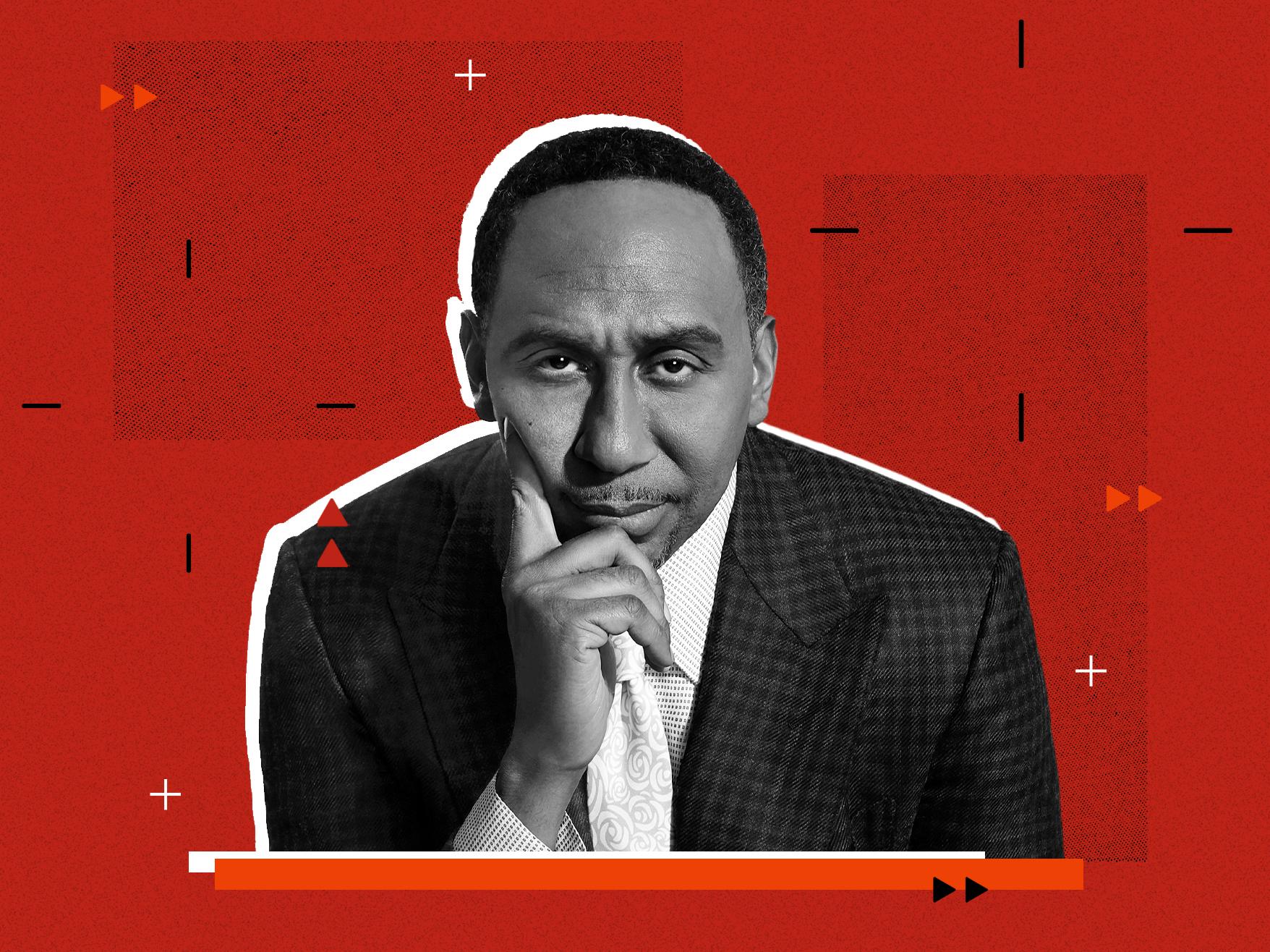
There are sports commentators. There are television personalities. Then there is Stephen A. Smith, a man who transformed shouting into branding, debate into commerce, and opinion into one of the most bankable commodities in modern media.
For over two decades, Smith has become impossible to ignore. Whether discussing the Dallas Cowboys, criticizing LeBron James, defending Shohei Ohtani, or sparring with politicians on cable news, Stephen A. Smith has transcended sports commentary entirely. He is no longer merely an analyst. He is an ecosystem.
And whether Americans love him, hate him, laugh at him, meme him, or scream back at their televisions because of him, they are still watching him.
That is the genius.
In many ways, Stephen A. Smith represents the evolution of American media itself. Loud. Fast. Emotional. Polarizing. Viral. Relentless. A machine built not necessarily to inform, but to dominate attention spans in a fractured digital age.
The modern media era did not create Stephen A. Smith.
Stephen A. Smith helped create the modern media era.
From Newspaper Ink to Television Fire
Long before the booming voice, the dramatic pauses, and the viral monologues, Stephen A. Smith was a journalist grinding through traditional sports media.
Born in the Bronx and raised in Queens, Smith came from a working-class environment where communication was survival. He attended Winston-Salem State University, the same institution that was once coached by the legendary Clarence Gaines. There, Smith sharpened the one weapon that would later make him famous: his voice.
Not just his speaking voice, but his perspective.
He eventually landed at The Philadelphia Inquirer, where he built a reputation as a fearless columnist willing to criticize athletes, coaches, ownership groups, and even hometown favorites. Philadelphia sports culture is unforgiving, emotional, and confrontational by nature, making it the perfect laboratory for Smith’s future persona.
He learned early that neutrality rarely creates influence.
Conviction does.
Even when readers disagreed with him, they read him. Even when athletes hated his columns, they responded to them. And in the media, reaction is currency.
By the early 2000s, ESPN recognized what newspapers could no longer contain. Smith was built for television.
ESPN and the Birth of the Debate Economy
When ESPN fully embraced debate television, Stephen A. Smith became its ideal soldier.
Programs like First Take did not merely discuss sports. They industrialized confrontation. The formula was deceptively simple:
One strong opinion.
One opposing opinion.
One emotionally charged argument.
Millions of viewers.
Smith perfected the format alongside personalities like Skip Bayless, creating a chemistry that bordered on performance art. Their debates often felt less like journalism and more like heavyweight title fights.
And audiences loved it.
The rise of social media amplified everything. Clips spread across YouTube, Twitter, Instagram, TikTok, and Facebook. A single Stephen A. Smith rant could generate millions of impressions within hours.
Traditional journalism valued nuance.
Modern television rewards certainty.
Stephen A. Smith understood this before many of his critics did.
He realized that audiences no longer consumed media patiently. They consumed it emotionally. The louder they take, the faster the clip travels. The more dramatic the delivery, the stronger the engagement.
In the age of algorithms, emotion beats information nearly every time.
Smith became a master of emotional broadcasting.
The Performance Behind the Persona
Many critics misunderstand Stephen A. Smith because they assume the television version of him is accidental.
It is not.
It is performance.
That does not mean he is fake. It means he understands television better than most television personalities understand television.
Watch his cadence carefully. The pauses. The widening eyes. The hand gestures. The escalating volume. The controlled outrage. The selective incredulity.
Every second is calibrated for audience retention.
Modern television is not simply about being correct. It is about preventing viewers from changing the channel.
Stephen A. Smith rarely loses the room because he understands rhythm. He speaks with the pacing of a preacher, the aggression of a trial lawyer, and the instinct of a stand-up comedian.
His critics often attack him for exaggeration, but exaggeration has become foundational to digital media economics.
Subtlety does not trend.
Nuance rarely goes viral.
Outrage spreads faster than restraint.
Smith recognized the architecture of internet-era attention long before legacy media fully adapted to it.
The Memeification of Sports Journalism
One of the most fascinating aspects of Stephen A. Smith’s career is how he became both an analyst and an internet meme simultaneously.
His reactions became GIFs.
His facial expressions became reaction images.
His monologues became TikTok audio.
His anger became entertainment independent of sports itself.
At some point, Stephen A. Smith stopped being merely a broadcaster and became a part of digital culture.
That transformation matters.
Previous generations of sports journalists existed within newspapers or scheduled broadcasts. Smith exists everywhere at once. Cable television. Podcasts. YouTube clips. Social feeds. Reaction videos. Sports betting integrations. Political commentary appearances.
He is not operating inside one media lane.
He is operating inside all of them.
That is why he remains relevant while many traditional analysts fade into obscurity. Smith adapted to the fragmentation of media consumption better than almost anyone in sports broadcasting.
He understood that modern audiences do not watch complete shows anymore. They consume moments.
Stephen A. Smith manufactures moments for a living.
The Economics of Attention
The most important thing to understand about modern media is this:
Attention is worth more than agreement.
Stephen A. Smith does not need everyone to like him. He only needs them to react to him.
Every reaction becomes engagement.
Every engagement becomes visibility.
Every visibility spike becomes advertising revenue.
This is the architecture of the modern attention economy.
In older eras, media companies prioritized trust and institutional authority. In today’s environment, platforms prioritize traffic, retention, and emotional engagement.
Smith thrives because he operates with complete awareness of this system.
He knows controversy travels.
He knows disagreement trends.
He knows sports fans are emotionally invested to irrational degrees.
And he knows that if he says something outrageous about the Los Angeles Lakers, the New York Knicks, or the Philadelphia Eagles, millions of fans will instantly respond.
In many ways, Stephen A. Smith is not merely commenting on sports culture.
He is monetizing tribalism.
Successfully.
Why Audiences Keep Watching
The obvious question remains:
Why does Stephen A. Smith continue dominating sports media despite constant criticism?
Because viewers trust passion more than perfection.
Even when audiences disagree with Smith, many believe he genuinely cares about the subjects he discusses. His delivery creates emotional authenticity. That matters in an era where many broadcasters sound robotic, overly cautious, or manufactured by corporate committees.
Smith sounds alive.
Audiences are exhausted by sanitized communication. They crave personalities who appear fearless, even if those personalities occasionally miss the mark.
Stephen A. Smith never appears afraid to speak.
That confidence itself becomes addictive television.
Furthermore, sports are inherently emotional. Fans are not seeking academic dissertations after a devastating playoff loss. They want passion reflecting their own emotional investment.
Smith provides catharsis.
When a star athlete collapses under pressure, Stephen A. Smith explodes on television in ways many fans wish they could themselves.
He transforms sports frustration into theatrical release.
The Criticism Is Part of the Product
Ironically, many of Stephen A. Smith’s loudest detractors help strengthen his brand.
Every viral criticism extends his reach.
Every angry quote tweet fuels the algorithm.
Every “Stephen A. Smith was wrong again” segment still keeps him at the center of sports discourse.
This is one of the defining realities of modern media. Outrage no longer destroys visibility.
It enhances visibility.
Smith understands this dynamic instinctively. He does not retreat from controversy because controversy fuels relevance.
And relevance is survival.
In a brutally competitive media environment where thousands of podcasts, YouTube channels, influencers, and sports creators compete for finite audience attention, irrelevance is death.
Stephen A. Smith refuses irrelevance.
Beyond Sports: Political and Cultural Commentary
Perhaps the clearest sign of Smith’s media evolution is his expansion beyond sports.
Over recent years, he has appeared more frequently discussing politics, race, economics, culture, and American society at large. Some praise this transition. Others criticize it fiercely.
But from a business standpoint, the move makes perfect sense.
Sports personalities today are no longer confined to sports. The lines between entertainment, news, politics, and celebrity culture have collapsed entirely.
Viewers increasingly follow personalities rather than institutions.
People do not merely watch ESPN anymore.
They watch Stephen A. Smith.
That distinction matters enormously.
Smith has cultivated a personal brand powerful enough to survive independently of any single network. Podcasts, radio appearances, YouTube content, interviews, books, and speaking engagements all strengthen that ecosystem.
He is not simply an employee.
He is intellectual property.
The Evolution of Masculinity on Television
Stephen A. Smith also represents a uniquely American form of televised masculinity.
Aggressive. Competitive. Verbal. Confrontational. Charismatic.
His style mirrors the energy of barbershop debates, street corner arguments, locker room conversations, and old-school sports radio simultaneously. He taps into a cultural rhythm many audiences instinctively recognize.
That style has become increasingly rare in corporate media environments dominated by caution and overproduction.
Smith feels unscripted even when he likely is not.
That illusion of spontaneity gives him tremendous power.
Viewers may not remember every statistic he cites. They may not remember every prediction. But they remember how he made them feel.
Emotion creates memory.
Stephen A. Smith understands emotional broadcasting better than almost anyone alive.
A Product of America’s Media Transformation
Ultimately, Stephen A. Smith’s success says as much about America as it does about him personally.
He emerged during the collapse of local journalism, the rise of cable opinion culture, the explosion of social media, and the monetization of outrage.
He adapted to every shift.
Newspapers declined. Smith pivoted.
Cable debates exploded. Smith dominated.
Social media emerged. Smith went viral.
Podcasts rose. Smith expanded.
Politics merged with entertainment. Smith adapted again.
That adaptability is extraordinarily rare.
Many talented journalists vanished because they could not adapt to technological change. Smith evolved repeatedly.
That is why he remains one of the most influential voices in sports media history.
Not because everyone agrees with him.
But because nearly everyone knows him.
The Stephen A. Smith Blueprint
There will be countless imitators in the years ahead.
Young creators will study his cadence, his confidence, his pacing, his dramatic timing, and his ability to command attention instantly.
But imitation is easier than replication.
Stephen A. Smith succeeded because his rise was rooted in legitimate journalism experience before becoming an entertainment spectacle. Beneath the theatrics exists a work ethic even many critics acknowledge.
By all accounts, Smith is relentless.
Preparation matters. Discipline matters. Endurance matters.
The camera amplifies personality, but consistency builds empires.
And Stephen A. Smith built one.
Final Thoughts
Love him or loathe him, Stephen A. Smith has become one of the defining media figures of the 21st century.
He is not simply a sports commentator. He is a symbol of where modern communication has gone: faster, louder, more emotional, more personality-driven, and infinitely more viral.
He embodies the transformation of journalism into entertainment and entertainment into nonstop algorithmic warfare for public attention.
In another era, Stephen A. Smith might have been merely a newspaper columnist.
In this era, he became a cultural institution.
That is not accidental.
That is mastery.
And whether America fully realizes it or not, Stephen A. Smith may very well be the perfect broadcaster for the age we created.
A Merged Insight Exclusive.



Leave a Reply