
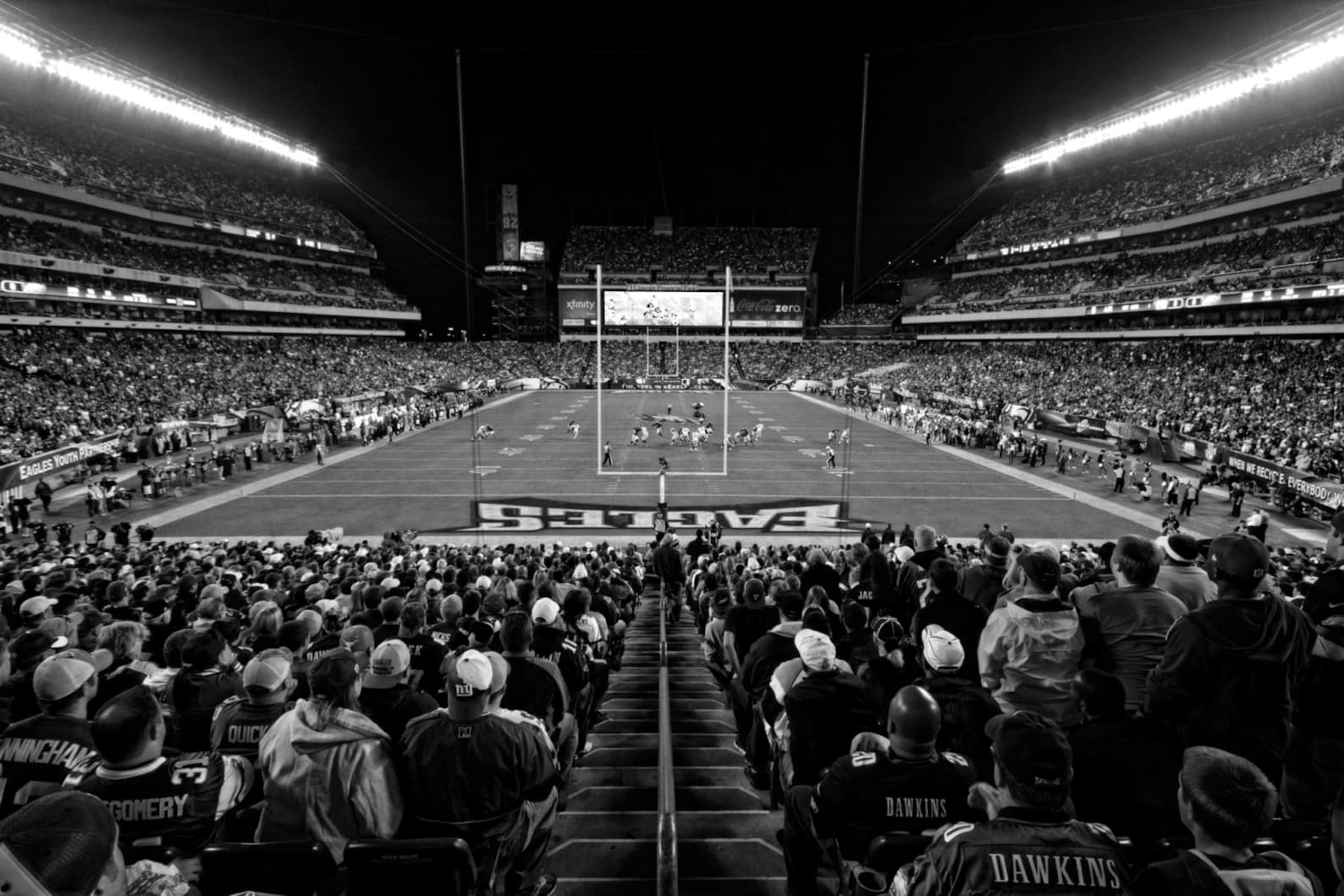
The air around the Jefferson Health Training Complex feels different this year. Following the strategic overhauls of the 2025 off-season and a deliberate, surgical approach to the 2026 NFL Draft, the Philadelphia Eagles are no longer just looking to compete in the NFC East — they are built to dictate the terms of engagement.
General Manager Howie Roseman has orchestrated a masterclass in roster construction, balancing high-priced cornerstone talent with calculated draft capital and low-risk, high-reward veteran signings. As the leaves begin to turn and the roar returns to Lincoln Financial Field, the blueprint for the 2026 season is clear. This isn’t a rebuild; it is a rapid reload centered on an explosive, multifaceted offense and a defensive depth chart designed to suffocate opponents through sheer rotational volume.
Here is the exclusive, definitive breakdown of why the Philadelphia Eagles are primed for a dominant 2026 campaign.
Jalen Hurts in the pocket. Source: 97.5 The Fanatic / Jalen Hurts Needs To Take More Risks Throwing The Ball – 97.5 The …
Saquon Barkley breaks a run. Source: Philadelphia Eagles / Highlights: Saquon Barkley’s best plays from 131-yard game vs …
A.J. Brown secures the catch. Source: Philadelphia Eagles / Highlight: A.J. Brown with the TD CATCH OF THE YEAR!
Dallas Goedert in an open space. Source: Sportsnet / Reports: Dallas Goedert, Eagles agree to one-year contract …
The Core Four: An Offensive Juggernaut
If you want to understand the ceiling of the 2026 Eagles, you have to look at the offensive skill positions. There is arguably no team in the NFL boasting a more potent, diverse, and physically imposing quartet than Jalen Hurts, Saquon Barkley, A.J. Brown, and DeVonta Smith.
The General: Jalen Hurts
Jalen Hurts remains the unquestioned leader of this franchise. While 2025 saw a dip in his rushing touchdown production, the evolution of his game from the pocket has been the quiet storyline of the offseason. With Kellen Moore’s system fully ingrained, Hurts is reading the field with a veteran’s cadence. He is no longer relying solely on his legs to bail out broken plays; he is manipulating safeties, exploiting the middle of the field, and delivering the ball with anticipation. The addition of veteran backup Andy Dalton provides a stable sounding board in the quarterback room, allowing Hurts to refine the cerebral elements of his game.
The Backfield Engine: Saquon Barkley
When the Eagles secured Saquon Barkley, it signaled a fundamental shift in their offensive philosophy. Barkley is a lock at running back, providing a dynamic that the franchise hasn’t possessed since the days of LeSean McCoy. Barkley’s ability to force missed tackles in space, combined with his elite pass-catching prowess, makes the Eagles’ RPO (Run-Pass Option) game nearly impossible to defend. If linebackers bite on the run, Hurts pulls and throws. If they sit back, Barkley is taking the handoff against light boxes. Furthermore, the Eagles have insulated Barkley with physical depth, bringing in Dameon Pierce and relying on the continued development of Will Shipley to ensure Barkley stays fresh for January football.
The Perimeter Locks: A.J. Brown and DeVonta Smith
There is no debate: A.J. Brown and DeVonta Smith are absolute locks on the outside, forming the most lethal wide receiver tandem in the league.
- A.J. Brown: Brown is the physical enforcer of the passing game. His ability to win at the point of attack, dominate 50/50 balls, and turn short slants into explosive gains forces defenses to roll safety help in his direction. He demands double coverage, acting as a gravitational pull that opens up the rest of the field.
- DeVonta Smith: “The Slim Reaper” continues to be the master of route-running and boundary control. Smith operates with surgical precision, exploiting the one-on-one matchups created by Brown’s presence. His body control and hands make him Hurts’ most trusted target on crucial third downs.
The Eagles didn’t stop there. By bringing in veteran speedster Marquise “Hollywood” Brown on a one-year deal and drafting the high-volume slot receiver Makai Lemon in the first round (No. 20 overall), the front office has ensured that this passing attack can stretch defenses horizontally and vertically.
The Anchor in the Middle: A Prime Tight End
While the wide receivers grab the headlines, the fulcrum of the Eagles’ mismatches lies at the tight end position.
Dallas Goedert returns on a restructured extension, entering the season as a prime, ferocious force in the middle of the field. Goedert is one of the rare “Y” tight ends left in the NFL who is equally devastating as an in-line blocker as he is a route-runner. When Goedert is on the field, defenses cannot accurately predict whether the Eagles are running a heavy zone scheme for Barkley or a play-action shot downfield. Goedert’s yards-after-catch (YAC) ability routinely turns standard check-downs into chain-moving conversions.
To compound this advantage, the Eagles heavily invested in the future of the position by drafting Vanderbilt’s Eli Stowers in the second round. Stowers, an explosive former quarterback converted to tight end, brings immense speed to the “F” tight end role. This allows Philadelphia to run heavy 12-personnel (one running back, two tight ends) while maintaining the speed of a four-receiver set.
To fully grasp how these pieces fit together, explore the interactive roster breakdown below:
Winning in the Trenches: The Offensive Line Transition
The legendary Jeff Stoutland continues to mold the best offensive line in football, but 2026 represents a subtle transition period.
The left side of the line remains an impenetrable fortress with Jordan Mailata at tackle and Landon Dickerson at guard. Cam Jurgens has firmly established himself as the anchor at center. However, the right side is where the intrigue lies. Lane Johnson remains an elite right tackle, but entering his age-36 season, the Eagles are preparing for the future.
Enter Markel Bell. Drafted in the third round out of Miami, the 6-foot-9, 346-pound behemoth has already been taking first-team reps during OTAs. Bell possesses exceptional length and power. While Johnson is the undisputed starter, Bell’s rapid development ensures that the Eagles have premium depth and a long-term succession plan, keeping Hurts upright and the running lanes wide for Barkley.
A Deep and Ferocious Defensive Depth Chart
While the offense generates the highlights, championships are secured by defensive depth. The 2026 Eagles defense is built on a philosophy of waves — keeping fresh, violent rushers on the field and deploying a versatile, ball-hawking secondary.
The Defensive Line: The Georgia Connection Matures
The interior of the defensive line is anchored by the terrifying combination of Jalen Carter and Jordan Davis. Carter, whose fifth-year option was swiftly picked up by the front office, is primed for an All-Pro season. His explosive get-off and violent hand usage make him a nightmare for interior linemen. Beside him, Davis has evolved into the ultimate run-stuffing nose tackle, commanding double teams that free up the linebackers.
The Edge Rushers: Speed and Rotational Power
The Eagles have assembled a track team on the edge. Nolan Smith Jr. and Jalyx Hunt provide the speed and bend to threaten the corner on every passing down. Understanding the need for situational depth, Roseman brought in Arnold Ebiketie and Joe Tryon-Shoyinka in free agency. This four-man rotation ensures that opposing offensive tackles will face fresh, high-motor rushers in the fourth quarter when the game is on the line.
The Linebacking Corps: Rebuilt and Ready
Historically, a position the Eagles have devalued in terms of cap allocation, the linebacking room has been retooled for modern football. Zack Baun returns after a statistically dominant 2025 campaign (123 tackles, 3.5 sacks), providing stability and leadership. The continued rise of Jeremiah Trotter Jr. adds a layer of sideline-to-sideline speed and legacy toughness that resonates deeply with the Philadelphia fanbase.
The Secondary: Length, Speed, and Versatility
The defensive backfield underwent a massive facelift to compete with the high-flying offenses of the NFC.
| Position | Key Players | Impact |
| Cornerback | Riq Woolen, Cooper DeJean, Jonathan Jones | Woolen brings size (6’4″) and freakish speed to erase boundary receivers. DeJean is the ultimate versatile chess piece. |
| Safety | Andrew Mukuba, Cole Wisniewski, J.T. Gray | Mukuba secures the deep third, while rookie Wisniewski provides downhill, in-the-box run support. |
The acquisition of Riq Woolen is particularly massive. His sheer size and recovery speed allow the defensive coordinators to play aggressive press-man coverage on the outside, knowing Woolen can run stride-for-stride with anyone in the league.
The Verdict: Why It Shall Be a Good Year
The NFL is an unforgiving league built on attrition, but the Philadelphia Eagles have built a roster designed to withstand the grind.
They are not relying on a single scheme or a single superstar. If a team sells out to stop Saquon Barkley, Hurts will shred them with A.J. Brown and DeVonta Smith. If a defense drops into deep coverage, Dallas Goedert and the offensive line will dictate the pace underneath. On the other side of the ball, the sheer depth of the defensive line ensures that opposing quarterbacks will not have the luxury of a clean pocket in crucial moments.
The 2026 season isn’t just about making the playoffs; it is about establishing a dominant era. With the perfect blend of prime veteran leadership, explosive young talent, and one of the most aggressive front offices in professional sports, the prospects for the upcoming season are not just bright — they are blinding.
It shall be a very good year in Philadelphia.
#GOBIRDS
A Merged Insight Exclusive.



Leave a Reply