

Currently, America cannot deny the fact that they are experiencing a massive institutional unchurching. You can take a closer look at the data and see for yourself that the headline is getting clearer.
‘Why is it so?’ May you ask?
The truth is this: mainline denominations are shrinking, and the cultural authority of the traditional Sunday morning service has waned.
But beneath the surface of this institutional collapse lies a paradox. The American religious impulse hasn’t vanished; it is definitely present. The only thing is that it has metastasized.
Far from entering a cold, hyper-rational secular age, modern America is awash in new forms of faith, ritual, and existential seeking. We didn’t kill our gods; we just evicted them from the churches and invited them into our politics, our wellness routines, and our digital spaces.
The Vacuum of the “Nones”
To understand where American faith is going, we first have to understand what happens when institutional religion recedes. Organized religion, for all its historic flaws and dogmatic rigidity, provided three critical social goods: a ready-made community, a coherent moral framework, and a profound sense of cosmic purpose.
When you remove the church, the human needs that the church used to satisfy do not magically disappear.
So, what happens?
They only get obvious – like the desire for belonging, the hunger for ritual, and the need to feel that one’s life is tethered to a grander narrative are deeply baked into human consciousness.
What we are witnessing today is a massive, decentralized scramble to fill that vacuum.
Consider the modern wellness industry. It is no longer just about physical fitness or nutrition; it has taken on a distinctly liturgical flavor. SoulCycle instructors act as secular priests, delivering motivational sermons over pounding bass lines. Veganism, clean eating, and biohacking are practiced with a dogmatic fervor reminiscent of ancient dietary laws. The yoga studio and the meditation app have replaced the pew, offering a secularized version of mysticism that promises transcendence without the baggage of sin and repentance.
We have traded the old catechisms for new ones. Instead of looking outward toward a transcendent Creator, the modern American is encouraged to look inward. The individual psyche has become the new holy of holies, and “authenticity” is our highest virtue.
The Sanctification of Politics
Perhaps the most consequential consequence of the unchurching of America is the religious transformation of our politics.
At least we can dutifully say that there is a positive side to the ‘unchurching’ spree.
Human beings are wired for tribal alignment and moral crusades. When traditional religious identities weaken, political identities rush in to absorb what is left of the fanaticism. Today, American politics is no longer a debate over tax rates, infrastructure spending, and policy trade-offs. It has become an arena of cosmic warfare; it is a battle between absolute good and absolute evil.
Both sides of the political aisle have adopted deeply religious structures:
The Political Left has developed a framework complete with its own concepts of original sin (systemic privilege), heresy (problematic speech), excommunication (cancel culture), and a vision of a future utopia achieved through social justice.
The Political Right has increasingly fused national identity with divine mandate, weaponizing apocalyptic rhetoric, longing for a restored golden age, and elevating political leaders to the status of flawed but divinely chosen prophets.
When politics becomes religion, compromise becomes heresy. You do not negotiate with the devil; you defeat him. The gridlock and vitriol defining modern American life are not merely the result of media polarization or gerrymandering; they are the symptoms of a deeply religious civil war being fought by people who think they are entirely secular.
The Digital Congregation
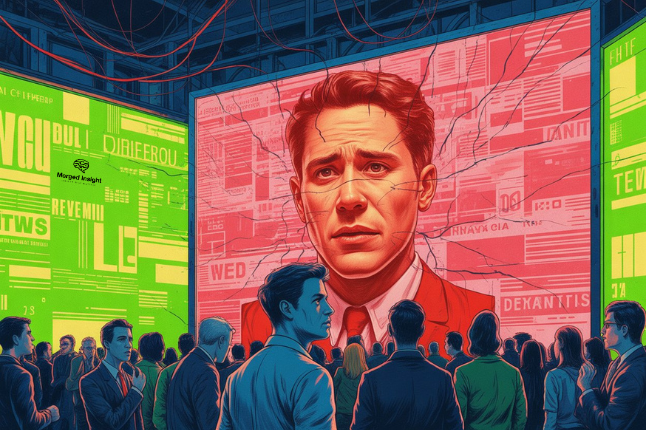
Simultaneously, the internet has rewritten how we experience the sacred. In the past, your religious community was defined by geography, the church down the street. Today, algorithmic feeds curate our spiritual tribes.
The online spaces have given rise to fragmented belief systems. We see the explosion of “algorithmically generated spirituality” from the mainstreaming of astrology and tarot among Gen Z to the dark, conspiratorial rabbit holes of QAnon, which operates with the exact structural mechanics of an apocalyptic doomsday cult.
Sadly, the internet allows individuals to DIY their faith. For example, a modern American can practice Buddhist mindfulness in the morning, consult their astrological birth chart at noon, afterwards, subscribe to a libertarian techno-optimist manifesto via Substack in the afternoon, and end the day practicing manifestation techniques learned on TikTok.
This may sound funny, but that is what the ultimate evolution of American individualism is: a religion of one, tailored precisely to the consumer’s psychological preferences. But a religion of one can be inherently lonely. It lacks the friction, the accountability, and the physical presence of a traditional congregation. It provides consumer satisfaction, but it rarely provides the durable comfort and presence needed in the face of suffering and death.
The Permanent Hunger
Where does this leave us?
America is currently caught in an uncomfortable space. The old gods are dead or dying in the hearts of millions, but the new surrogates, which are politics, wellness, consumerism, and digital tribalism are proving to be poor substitutes. They only offer the intensity of what religion looks like without its ability to heal; they demand sacrifice but offer no grace or forgiveness.
The current trends suggest that the future of American belief is not a sterile, godless landscape. Instead, it will likely be a hyper-pluralistic, chaotic marketplace of competing spiritualities, where the line between the sacred and the secular is permanently blurred.
The enduring lesson of the 21st century so far is that the religious impulse is a permanent feature of the human condition. We are meaning-making creatures. If we cannot find God in the heavens, we will invent him on our screens, in our political parties, or in ourselves. The sacred echo persists, reminding an anxious, hyper-connected nation of morally diverse humans that we cannot live by bread, data, or politics alone.



Leave a Reply