
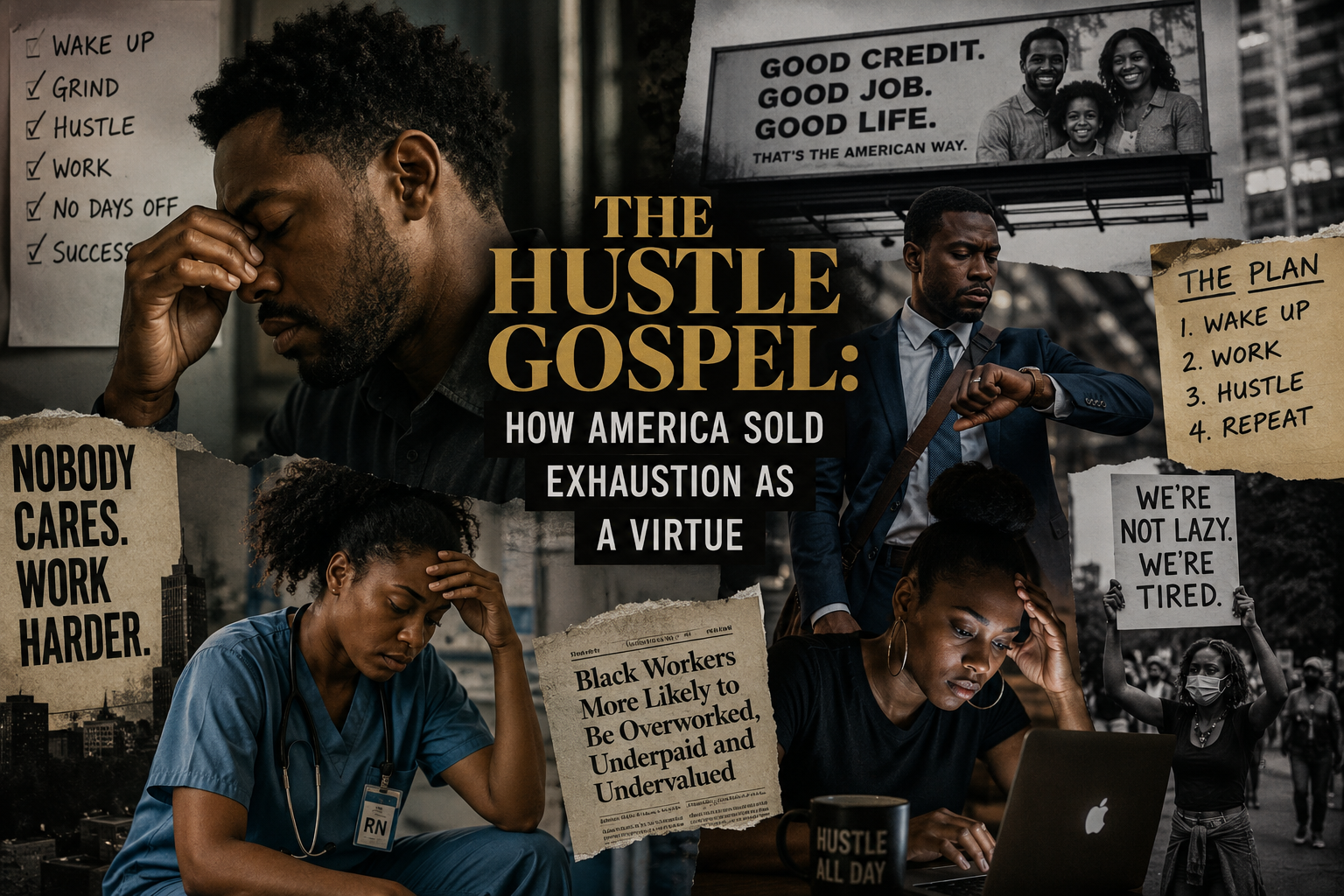
There is no more effective mechanism of social control than convincing a population to police itself. For the better part of three decades, American culture has done exactly that through the gospel of hustle.
The gospel of hustle is a value system so thoroughly embedded in the national psyche that to question it feels, to many, like a confession of weakness. When you suggest that rest is not laziness, or that a person’s worth is not synonymous with their productivity, you invite suspicion. In America, exhaustion has been rebranded as ambition, and the country bought it wholesale.
The Architecture of a Belief System
Hustle culture did not arise from the blues. It was first constructed, brick by brick, through decades of corporate messaging, self-help mythology, and the peculiarly American fusion of Calvinist work ethic with consumer capitalism.
The message was elegantly simple: your suffering is an investment, and success is its guaranteed return.
This is one of the reasons why immigrants believe that when you put in the work, you will definitely get paid commensurate with your effort.
It is one of the best reasons why most immigrants would choose the Skilled Immigrants path into the USA or UK.
This framework served institutional interests far more than it served individuals. A workforce that defines its worth by its output is a workforce unlikely to organize, to rest, or to demand better conditions. The hustle gospel was, in its most cynical reading, a brilliant act of class management disguised as personal empowerment.
The Reckoning
What hustle culture failed to account for was the human body’s fundamental unwillingness to comply indefinitely. A prime reminder that the body wouldn’t do much without appropriate rest at different times.
By the early 2020s, a generation that had done everything the gospel demanded in terms of the degrees, the unpaid internships, the seventy-hour weeks arrived at its promised rewards to find them absent.
They found out that wages had stalled. Housing had become inaccessible. Burnout had reached epidemic proportions. The return on suffering isn’t a reality yet.
The cultural response to this reckoning has been swift and, to the architects of hustle culture, deeply unsettling. The “soft life,” which is a deliberate, principled rejection of the grind-as-identity framework has emerged not as a simple philosophy but as a generational consensus. It is a forensic audit of a contract that was never honored, and a refusal to keep signing it.
Research from the American Institute of Stress consistently identifies workplace demands and financial pressure as the leading drivers of chronic stress in American adults. The bodies that hustle culture claimed as willing instruments have registered their dissent in the form of record diagnoses of anxiety, depression, and burnout-related illness.
The Stakes
To dismiss the rejection of hustle culture as a mere trend is to miss its significance entirely. What is being negotiated, beneath the surface of social media aesthetics and generational discourse, is a fundamental question about what a life is for. The hustle gospel answers the fact that a life is for constant producing instead of a calculated rest in between.
America built its identity, in no small part, on the myth of the self-made individual who outworked everyone in the room. To examine that myth critically, to ask who it served, who it harmed, and whether it was ever true is to undertake an act of complete cultural archaeology that the country has long avoided.
That excavation is now underway, and what it uncovers may be the most important cultural conversation of this generation.




Leave a Reply